
How to Find Hamilton County Arrest Records
A recent arrest in the county lands a person in the Hamilton County Jail and Detention Center. The Sheriff's Office runs the jail and posts a live inmate search. You search by last name or by SPN, the booking number the jail assigns at intake. That tool is the fastest way to confirm someone is in custody right now.
Booking is the first step. Jail staff identify the person, log the charge, take a photo, and record court data. Bond, judge, division, and court date can then appear on the public profile. None of this proves guilt. It only records that an arrest and booking happened.
The inmate search and the broader county criminal case display are separate tools. One shows who is in jail today. The other shows criminal charges that have moved into court. Use both to get the full picture of a Hamilton County arrest.
- Open the Sheriff's inmate search and pick last name or SPN.
- Enter a full last name; a partial name returns a longer list.
- Open the matching profile to read the charge, bond, judge, and court date.
- For court history, switch to the county criminal case display and search by defendant name.
- For an official copy, contact the Criminal Court Clerk and pay the search or certification fee.
You can reach the HCSO inmate search to look up a current booking by last name or SPN. The same page links the Tennessee Sex Offender Registry, VINE victim notification, and the jail contact block.
Hamilton County Booking and Jail Roster
The jail roster is the public record of who sits in county custody. Sheriff Austin Garrett's office maintains it, and the Hamilton County Jail and Detention Center holds the people listed on it. A booking profile is built when someone is processed in. The roster updates as people are booked, released, or moved.
What shows on a profile is limited but useful. A photo area, the name, and date of birth appear at the top. Below that you may see a bond amount, the judge, the court division, and the next court date. A VINE link lets victims register for custody alerts. Visit setup runs through a separate provider.
The roster does not list every field a full booking sheet holds. Charge codes, holding location, arrest agency, and release date are not always shown on the public view. For those, call the jail or the clerk.
| Field | What It Shows |
|---|---|
| Photo | The booking mugshot, or a placeholder when no photo is posted |
| Name | Last, first, and middle name of the person in custody |
| Date of Birth | The inmate's DOB, used to tell apart common names |
| Bond Amount | The dollar amount set for release before trial |
| Judge and Division | The assigned judge and court division number |
| Court Date | The next scheduled hearing date |
| VINE Link | A link to register for victim notification on custody changes |
If a name is not on the roster, that does not prove release. The person may have bonded out, moved to another facility, or never been booked in this county. The jail line is 423-209-7125 for a direct check.
Note: Absence from the current roster is not proof of release, since people move, bond out, or transfer between jails without a public flag.
Arrest Record vs Criminal Court Record
People mix up these two records all the time. An arrest record is created by law enforcement at booking. A criminal court record is created by the court once a case is charged and filed. They come from different offices, hold different data, and update on different clocks. One can exist without the other.
The table below sets them side by side so the split is clear. Both can be public, but each answers a different question about a person's history in Hamilton County.
| Arrest Record | Criminal Court Record |
|---|---|
| Made by the Sheriff or arresting agency at booking | Made by the court after charges are filed |
| Found on the HCSO jail roster and inmate search | Found on the county Court Case Display |
| Shows the booking, photo, bond, and custody status | Shows charges, hearings, pleas, and the disposition |
| Means a person was taken into custody | Means the state filed a case in court |
| May exist with no court case if charges drop | May exist even if the person was never jailed |
For the full case history behind an arrest, the court file is the right source. See Hamilton County court records for how to search civil and criminal case files across the county's portals.
Charges vs Convictions in Hamilton County
An arrest and a charge are not a conviction. A charge is what the state says a person did. A conviction is what a court found true after a plea or trial. Many charges end in dismissal, a not-guilty finding, or a nolle prosequi, which means the prosecution will not go forward. Reading a record without that distinction is a common mistake.
The disposition field on a court record carries the answer. It may read as a guilty plea, a dismissal, or stay blank while a case is open. A blank disposition does not mean guilt. It often just means the case has not closed yet.
| Charges | Convictions |
|---|---|
| An accusation filed by the state | A final court finding of guilt |
| Can be dropped, dismissed, or reduced | Entered after a plea or trial verdict |
| Does not prove a person did anything | Carries legal weight and lasting record effects |
| Shown at booking and at the start of a case | Shown in the case disposition field |
The county's own criminal display warns that its data is not official and that names can be confused. Positive identity cannot be made from a public screen alone, because many people share the same name. Always confirm a charge or conviction with the clerk before you rely on it.
Note: A blank disposition usually means the case is still open, not that the person was found guilty of the charge.
Public and Restricted Arrest Records
Tennessee law keeps most adult arrest and criminal records open. The Tennessee Public Records Act, at Tennessee Code § 10-7-503, gives citizens the right to inspect state, county, and municipal records during business hours unless a law makes a record confidential. Tennessee Supreme Court Rule 34 carries that right into court records. So a typical adult booking and criminal case file is public.
Some records are closed, though. Juvenile files are confidential under Tennessee Code § 37-1-153. Sealed records and protective-order material stay shut without a court order. Personal identifiers like Social Security and account numbers are redacted on public displays.
The state court system spells out the public access rule for court records, including the limits that keep some files closed.
You can read Tennessee Supreme Court Rule 34, which defines court records and lists what is open and what is excepted.
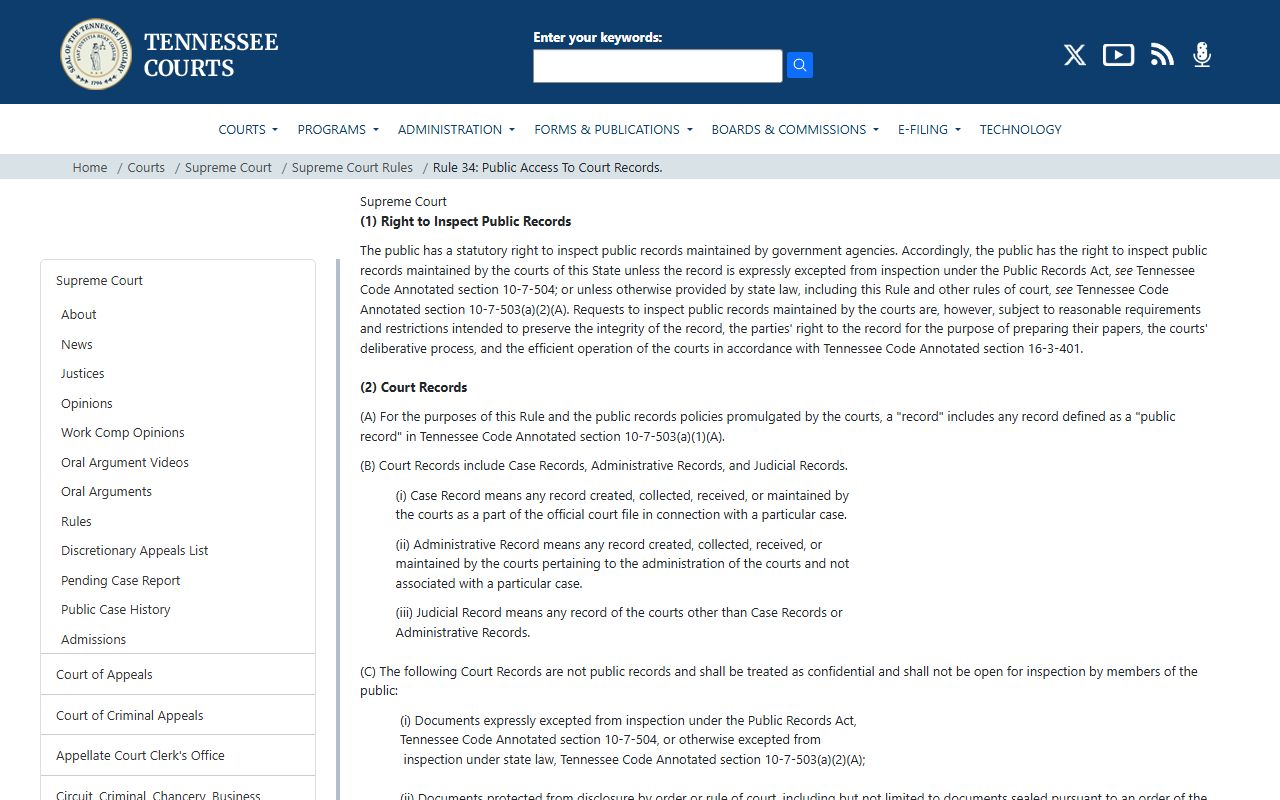
Rule 34 is the rule a clerk points to when deciding whether an arrest-related court file can be released.
- Sealed record
- A file closed from public view by law or court order.
- Juvenile record
- A minor's court file, confidential under state law.
- Redaction
- The removal or masking of confidential data on a public copy.
- Disposition
- The outcome of a charge, such as a plea, dismissal, or verdict.
The Tennessee Bureau of Investigation
For a statewide criminal history, the Tennessee Bureau of Investigation is the central agency. The TBI keeps the state criminal-history file built from arrests and dispositions reported by local agencies like the Hamilton County Sheriff. A county roster shows local custody. The TBI file pulls records from across Tennessee.
The TBI also runs background-check services and posts a Most Wanted list. Hamilton County's own sheriff page links the TBI and its top fugitives, which ties the local and state systems together.
The bureau's main page is the front door to its programs, including criminal history and registry services.
Start at the Tennessee Bureau of Investigation home page for state criminal-history and background-check programs.
The TBI file is the record most employers and agencies check for a full statewide criminal history.
The bureau's wanted list shows the state's most-sought fugitives and is linked straight from the Hamilton County Sheriff's site.
You can view the TBI Top 10 Most Wanted list for active statewide fugitive alerts.
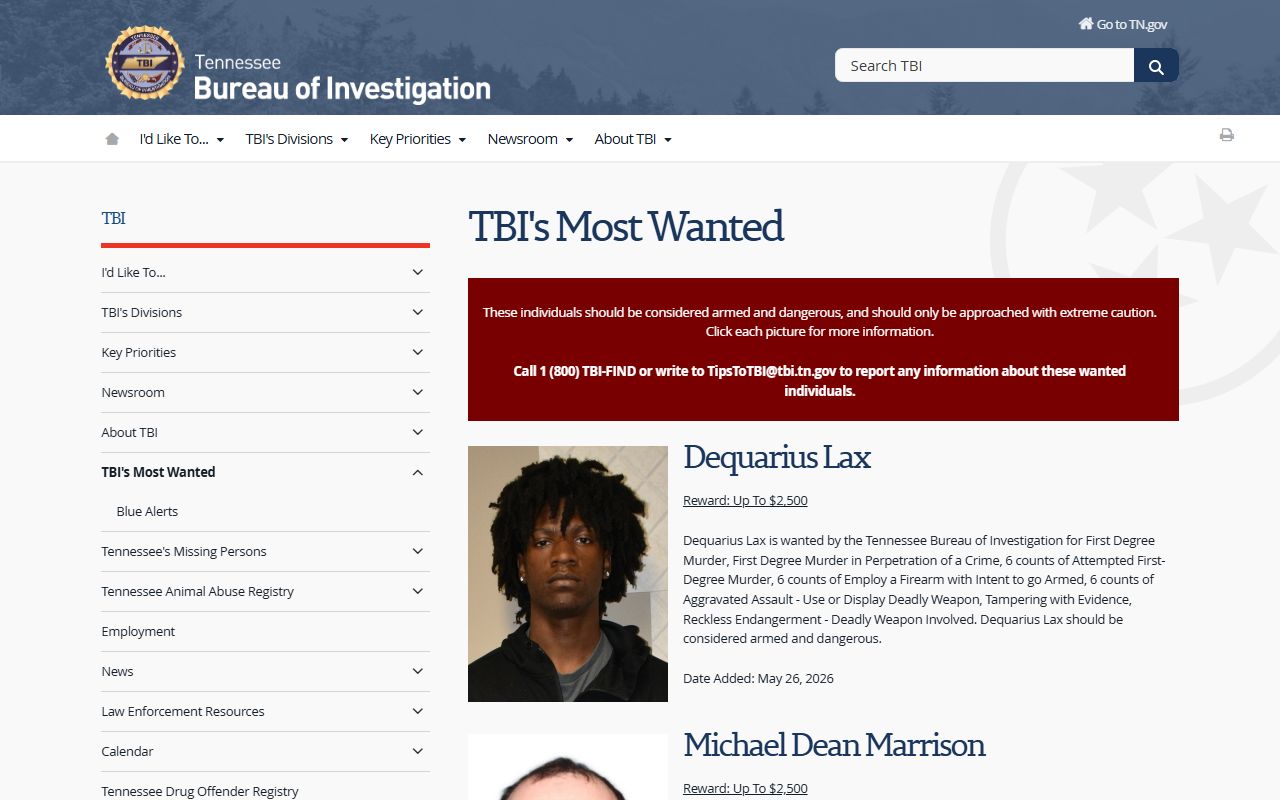
A name on that list signals an active warrant; for local open warrants, check the county tool instead.
Expungement of Hamilton County Arrest Records
Expungement erases the legal record of some cases in the eyes of the law. It is not automatic. A person files in the court where the matter started, here in Hamilton County. The Tennessee courts explain that the clerk must remove eligible public records from electronic databases once an order is granted.
Some expungements are free. Tennessee Code § 40-32-101 allows free expungement when charges were dismissed, when no true bill was returned, when a trial ended in not guilty, when the case ended in nolle prosequi, or when a person was arrested and released without a charge. Diversion and conviction expungements can carry fees and added rules.
The state court system posts plain-language guidance on who qualifies and how to start.
Read the Tennessee expungement information page for eligibility categories and the local filing process.
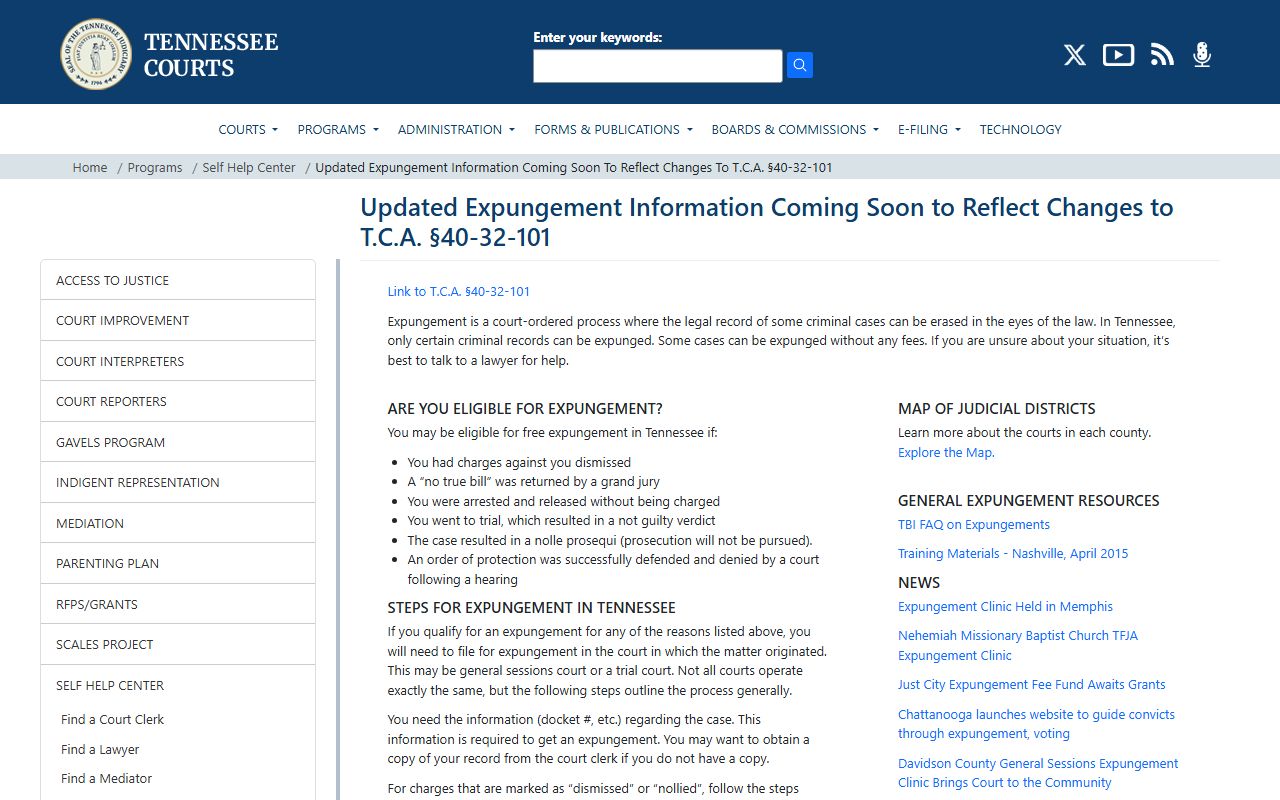
Common reasons for denial include an ineligible conviction, unpaid costs, a short waiting period, or filing in the wrong court.
After a local order, the change spreads to other agencies. The arresting agency, the county jail, the Department of Correction, and the TBI all get notified so their files match.
See the AOC and TBI expungement FAQ for how an order moves from the local court to state agencies.
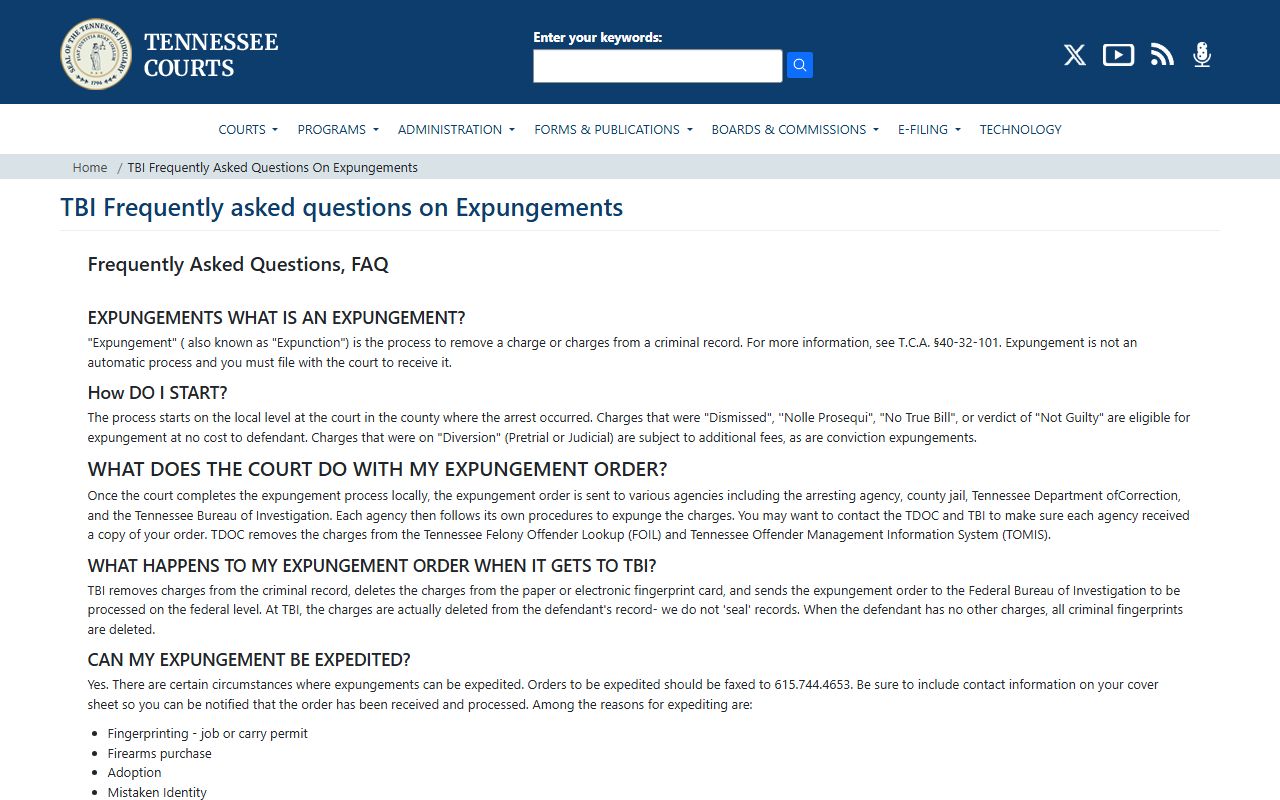
An expunged arrest should drop off both the local display and the state criminal-history file once every agency updates.
Sealed vs Expunged Records
Sealing and expunging sound alike but differ in effect. A sealed record still exists; it is just hidden from public view and can be reopened by court order. An expunged record is removed or destroyed, so eligible public copies come off the clerk's electronic databases for good. The legal weight of each is not the same.
| Sealed Record | Expunged Record |
|---|---|
| Closed from public view by law or order | Removed or destroyed under a court order |
| The file still exists and can be reopened | Eligible public copies are erased from databases |
| Often used for protective-order or sensitive files | Used for dismissed, acquitted, or eligible cases |
| Access needs a court order | Treated in law as if the case never happened |
Both routes start with a filing in the court that holds the file. The clerk and the judge decide what the law allows for a given case.
Verifying Hamilton County Arrest Records
Online tools are a starting point, not the last word. The county's criminal display says plainly that it is not official and that recent events may lag. For a record you can rely on in court or for a job, you need certified documentation from the clerk. The Criminal Court Clerk, Vince Dean, handles that for criminal and Sessions criminal matters.
The clerk's office charges a fee to search records and to provide certified copies. Bring a full name or a case number. Certified copies are the version courts and agencies accept, while a screen printout is for reference only.
Hamilton County Criminal Court Clerk
600 Market Street, Room 102
Chattanooga, TN 37402
423-209-7500
Mon-Fri 8:00 a.m. to 4:00 p.m.
Criminal and Sessions criminal case display is at cjuscaseinfo.hamiltontn.gov. You can search by Defendant Name, Case Number, Driver's License, Social Security, or SPN. A defendant-name search needs a last name, with first and middle optional. For office details and certified copies, see the Criminal Court Clerk page.
Arrest Records and Background Checks
People run arrest checks for jobs, housing, and licensing. A few rules matter before you act on what you find. An arrest is not proof of a crime. A dismissed or expunged case should not count against a person. And public displays can carry the wrong person under a shared name.
For a formal background check, the TBI is the right state source, not a county roster. The roster shows who is in jail now. A full criminal history needs the state file. For traffic-linked criminal matters like DUI, the case may sit in the criminal courts.
DUI and DWI cases are criminal and often start with an arrest. See Hamilton County traffic court records for how impaired-driving and other traffic-criminal cases are searched and where they route.
If an arrest produced an open warrant, that is tracked separately by the Sheriff. Check Hamilton County warrant records to see active warrants, and Hamilton County inmate records to confirm current custody status.