
How to Run a Hamilton County Warrant Search
The Hamilton County Sheriff's Office hosts the open warrants search. Sheriff Austin Garrett's office posts the tool online so anyone can check a name. You do not need an account. You enter a name or a warrant number, run the search, and read the result.
Keep the search simple. A full name works better than a first name alone. A known warrant number returns the most exact match. The tool is built around those two inputs and nothing more.
The open warrants page also carries an important limit. Its data is pulled from the Hamilton County court system and updated once each day. So a brand-new warrant may not show yet, and a warrant that was just cleared may still appear. Read every result with that timing in mind.
You can reach the HCSO open warrants search to look up an open warrant by name or warrant number. The same page posts the daily update notice that governs how current the data is.
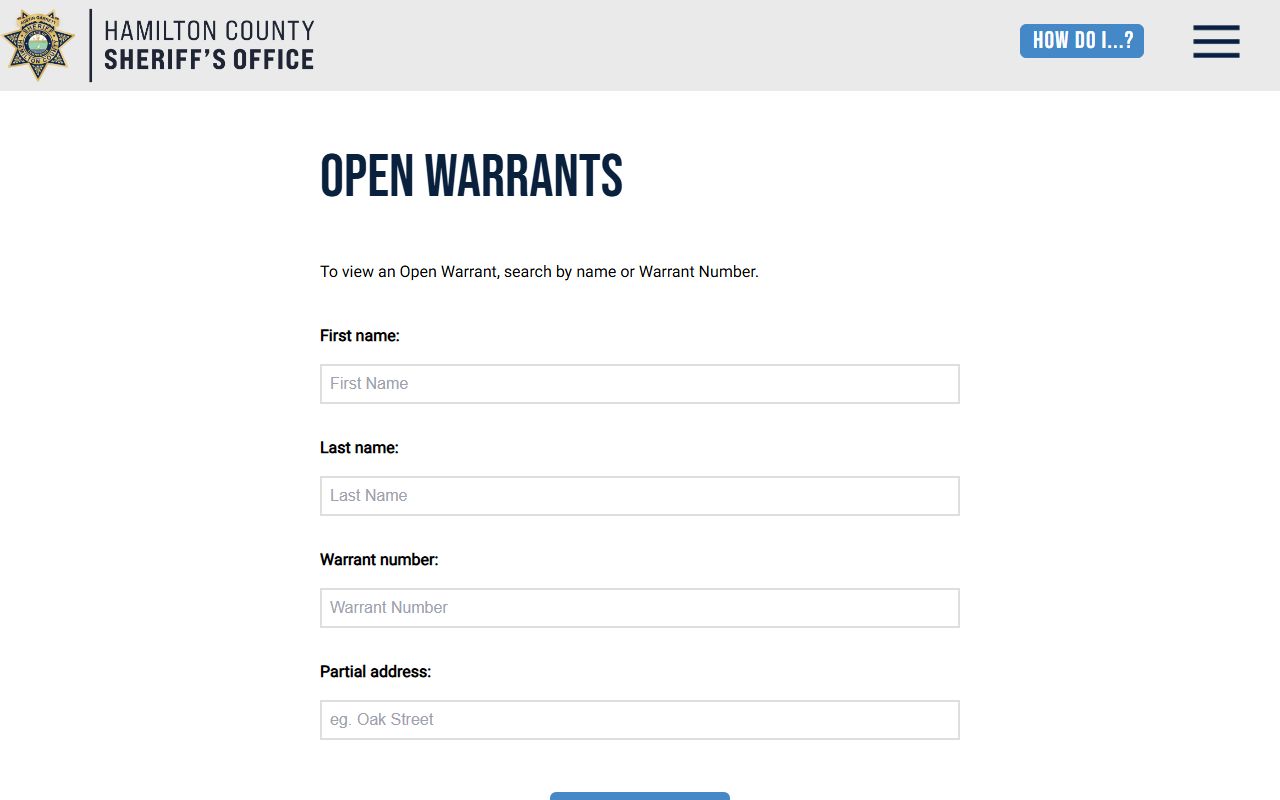
That page is the official starting point for any Hamilton County warrant search.
Hamilton County Warrant Search Fields
The open warrants tool keeps its form short. The page tells users to search by name or by warrant number. You only need one of the two. Filling in either field runs the lookup, so you do not have to know both to get a result.
The table below lists the search fields so you know what to expect before you open the page. A name search casts a wider net, while a warrant number points at a single record.
| Field Label | Type | Required | Notes / Format |
|---|---|---|---|
| Name | Text | Optional if warrant number used | Search an open warrant by a person's name; a full name narrows the list |
| Warrant Number | Text | Optional if name used | Search by an exact, known warrant number for a single match |
| Search | Button | n/a | Runs the warrant lookup against the current daily data |
Because either field works alone, start with a name if you do not have the number. Switch to the warrant number when you have it, since that cuts through common-name overlap.
Types of Warrants in Hamilton County
Not all warrants are the same. A court or judge issues different kinds for different reasons. The open warrants tool mostly surfaces arrest and bench warrants tied to county court cases. Knowing the type helps you understand why a warrant exists and how to clear it.
An arrest warrant rests on probable cause that a person committed a crime. A bench warrant, also called a capias, can issue after a missed court date, a violation, contempt, or a failure to comply with an order. A search warrant authorizes a search and is usually not listed in public before it is served.
Some warrants reach across county or state lines. A fugitive or out-of-county warrant may involve a hold or extradition. There are also civil warrants, which in Tennessee General Sessions relate to civil process and claims, not criminal arrest.
- Arrest warrant: authorizes arrest based on probable cause of a crime.
- Bench warrant or capias: issued after a missed court date, violation, or contempt.
- Search warrant: authorizes a search; often not public before it is served.
- Fugitive warrant: involves an out-of-county or out-of-state hold or extradition.
- Civil warrant: a General Sessions civil process tied to a claim, not an arrest.
The open warrants tool focuses on criminal arrest and bench warrants. For civil warrant procedures in General Sessions, the case file lives with the court that issued it.
The Daily Update Limit on Warrant Data
This is the single most important thing to know about the tool. The Sheriff's open warrants database is updated once a day, at 4:00 p.m. It is built entirely from information the Hamilton County court system provides. Anything that changed after the last refresh will not show until the next one.
That timing cuts both ways. A new warrant issued this morning may not appear until the afternoon update. A warrant that was recalled or paid today may still show as open until the data refreshes. The public view is a snapshot, not a live feed.
Important: The open warrants database updates daily at 4:00 p.m. from Hamilton County court data, so a recent or resolved warrant may not match what the screen shows. Confirm any result with the issuing court or the Sheriff before you rely on it.
Because of the lag, never treat a result as final. If a warrant matters for a legal or personal decision, call the issuing court or the Sheriff's Office and confirm the current status by phone.
How to Resolve an Outstanding Warrant
Finding a warrant is only the first step. Clearing one takes action through the court and, often, an attorney. A warrant does not go away on its own, and ignoring it usually makes things worse. The steps below outline a safe path to resolve an outstanding Hamilton County warrant.
Start with the search, but do not stop there. Because the data lags, verify the warrant by phone before you act. Then sort out bond and where the case is heard so you arrive prepared.
- Search HCSO open warrants by name or warrant number to confirm a warrant may exist.
- Because the data updates daily at 4:00 p.m. and may lag, call HCSO or the issuing court to confirm.
- Contact an attorney or the public defender if criminal charges are involved.
- Find out whether bond is set and where it must be posted.
- Appear in the issuing court or turn yourself in as instructed; do not assume an online clear means it is gone.
- Keep proof of any recall, quash, payment, or disposition until every agency updates.
Note: A warrant dropping off the online tool is not proof it is cleared, so keep your paperwork until the courts and the Sheriff all confirm the change.
Bond and Court Contact for Hamilton County Warrants
Bond and court details depend on the case behind the warrant. The Criminal Court Clerk holds criminal and Sessions criminal case files and can point you to the right division. Criminal Court is split into three divisions, each with its own line, which helps when you need to reach the court that issued a warrant.
For an official record of the case tied to a warrant, the clerk is the source. The office charges a fee to search records and to provide certified documentation. A screen result is for reference only.
The three Criminal Court divisions each carry a direct line. Division I is 423-209-7574, Division II is 423-209-7560, and Division III is 423-209-7555. The main clerk line at 423-209-7500 can route you if you are not sure which division holds the case. Bond questions, court dates, and recall paperwork all run through the division handling the matter, so the right phone number saves time.
Hamilton County Criminal Court Clerk
600 Market Street, Room 102
Chattanooga, TN 37402
423-209-7500
Mon-Fri 8:00 a.m. to 4:00 p.m.
If the person named in a warrant is already in custody, the jail roster will show bond and the next court date. Check Hamilton County inmate records for current custody, or the Criminal Court Clerk page for office details and certified copies.
Why a Resolved Warrant Still Appears
It catches people off guard. You paid, the court recalled the warrant, yet the online tool still lists it. The reason ties back to the daily update. The Sheriff's data mirrors the court system once a day, so a change made after the last refresh has not synced yet.
There are a few common reasons a cleared warrant lingers on the screen. The court entry may not have posted before the 4:00 p.m. refresh. The agencies may not have all updated their files. Or the recall paperwork may still be moving between offices.
- The change happened after the last daily update at 4:00 p.m.
- The court has not yet posted the recall or quash to its system.
- Different agencies update their copies on different schedules.
- Paperwork proving the recall is still in transit between offices.
This is exactly why keeping proof matters. Hold your receipt, recall order, or disposition until the public tool catches up and every office reflects the change.
Reporting and Contacting the Issuing Court
Some people search warrants to report a fugitive rather than clear their own case. For that, the right move is to contact law enforcement, not to act alone. The Sheriff's non-emergency line takes tips, and 911 is for emergencies only. Never try to serve or detain anyone yourself.
If your goal is the case itself, the issuing court is the place to call. Criminal and Sessions criminal matters route through the Criminal Court Clerk. For full case history behind a charge, the county criminal display and the court file fill in the details.
To see charges and dispositions tied to a warrant, look at Hamilton County arrest records and the broader Hamilton County court records. Those pages explain the criminal display and the clerk's certified-copy process.
Note: The Sheriff's non-emergency line is 423-622-0022 and emergencies are 911; do not attempt to serve or act on a warrant yourself.