
Hamilton County Marriage and Divorce Records
Two records, two offices. That is the first thing to know. A marriage license is a county record. A divorce decree is a court record. In Hamilton County the County Clerk handles the license side, and the trial courts handle the divorce side. The clerk who keeps each file is the one who can certify a copy.
Bill Knowles serves as the Hamilton County Clerk, and his office is the marriage-license office for the county. The clerk issues the license, records the return after the ceremony, and keeps the search index. Tennessee law requires a license from a county clerk before any marriage can take place, so the clerk's office is where the process begins. You can pre-enter your information online and finish at the counter.
Divorce is a court matter. Hamilton County Circuit Court hears domestic cases that include divorce, and Chancery Court also handles domestic relations. The court that heard the case keeps the decree, and that clerk issues certified copies. For a statewide check, the Tennessee Office of Vital Records also holds registered marriage and divorce events.
For estate and guardianship files, see Hamilton County probate records. For the broad open-records framework, see public records.
Hamilton County Marriage License Portal
The county runs an online marriage portal where you can do most of the work before you ever set foot in the office. The site lets you apply for a license, request a certificate copy, search past licenses, and print reports. It is the fastest way to start a Hamilton County marriage records search from home. The portal has its own login for repeat users, but a basic search does not need an account.
The portal also carries an important date note. Its records run from 1857 through August 3, 2021. For any license issued after that date, you call the County Clerk's office at 423-209-6500 rather than searching the site. That cutoff trips up a lot of people, so check the date before you assume a record is missing.
You can reach the Hamilton County marriage license portal for license applications, certificate requests, and name-based searches.
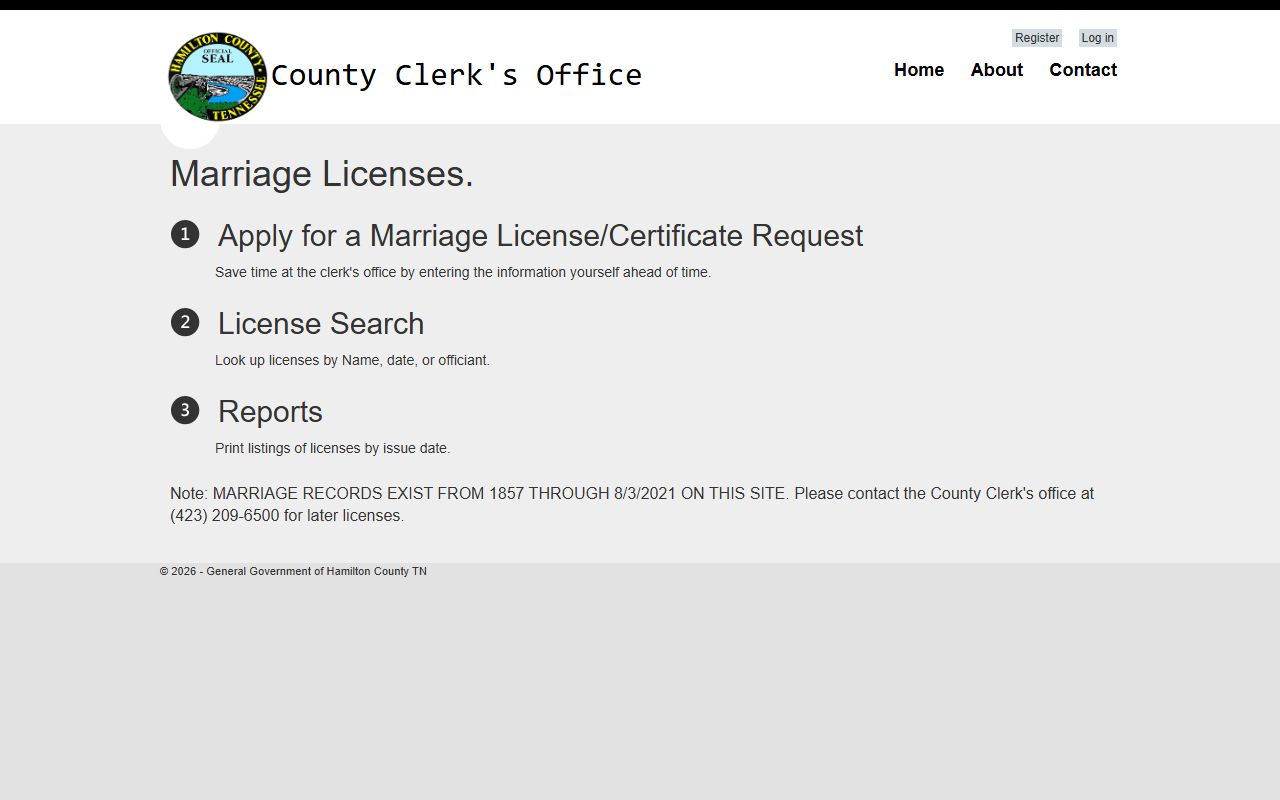
The home screen groups its tools into a few clear buttons, and the table below lists what each one does so you pick the right one on the first try.
| Portal Tool | Type | What It Does |
|---|---|---|
| Apply for a Marriage License / Certificate Request | Workflow | Pre-enter your details to save time at the counter, or request a copy of a license |
| License Search | Search | Look up licenses by name, date, or officiant |
| Reports | Report | Print listings of licenses by issue date |
| Login | Account | Optional sign-in for repeat or office users |
The License Search is the tool most people want. Type a name and you can scan the issued licenses for that period.
How to Apply for a Hamilton County Marriage License
Getting a license is a counter visit, but you can cut the wait with the online tool. Tennessee requires the license before the ceremony, so plan ahead of the date. The steps below follow the county's own process. Fees and ID rules are set by the clerk, so confirm them by phone before you go.
- Use the Hamilton County marriage portal to pre-enter your application or certificate request online.
- Call the County Clerk at 423-209-6500 about later licenses and any current rules, ID, or fees.
- Bring the required ID and payment to the County Clerk's office.
- Have the ceremony performed by an authorized officiant.
- Make sure the signed license is returned and recorded with the clerk.
The return step matters. A ceremony alone does not finish the record. The officiant signs the license and it goes back to the clerk, who records it and makes it part of the searchable index.
Tennessee marriages need a license from a Tennessee county clerk first. The county clerk marriage page makes that plain. You can read the rule on the Hamilton County Clerk marriage information page, which states a county clerk must issue the license before a marriage can occur.
Marriage License Fees and What to Confirm
The marriage license fee, ID list, and any waiting period are not posted in the official pages reviewed for this section. That is normal. Clerk fees change, and the safest number is the one the office gives you on the day you call. So the right move is a quick phone check before you head downtown.
Call the County Clerk at 423-209-6500 for the current fee, accepted payment types, and ID rules. Tennessee also offers a discount on the license fee for couples who finish an approved premarital course, but the local rules and amount should be confirmed with the clerk, not guessed.
What to confirm before you go: the current license fee, accepted payment methods, the ID each party must bring, any premarital-course discount, and whether both parties must appear in person.
Note: Exact marriage license fees were not published in the official sources for this page, so call the County Clerk for the current amount before you visit.
Hamilton County Divorce Records and Decrees
Divorce records are court records, not clerk-of-county records. In Hamilton County two courts handle them. Circuit Court hears domestic matters that include divorce. Chancery Court also handles domestic relations. The case lands in one or the other, and that court's clerk keeps the official file and the final decree.
Because the file can sit in either court, your first job is to find out which court heard the case. A divorce filed in Circuit Court may be searchable through the Circuit clerk's case tools, while a Chancery divorce shows up in the Hamilton County Online Court Records System for equity cases. A certified divorce decree comes from the clerk of the court that handled the matter, so you request the copy from that office.
The county also points divorcing parents toward extra steps. The court page links a "Divorce Mediation and Parenting Plan" resource. Parents in the divorce process are required to form a parenting plan and take part in some form of divorce or mediation training. That requirement is part of the case, and the orders tied to it become part of the record.
For a statewide check, the Tennessee Office of Vital Records holds registered birth, death, marriage, and divorce events for the state.
Which Court Holds a Hamilton County Divorce
Knowing the court tells you the clerk, and the clerk tells you where to send the request. Circuit and Chancery split the domestic caseload, and each has its own clerk and its own contact. The cards below give the two main court offices that touch divorce records, plus the criminal-side clerk for cross-reference.
Hamilton County Circuit Court Clerk
500 Courthouse, 625 Georgia Avenue
Chattanooga, TN 37402
423-209-6700
Mon-Fri 8:00 a.m. to 4:00 p.m.
Clerk and Master / Chancery Court
Hamilton County Courthouse
Chattanooga, TN 37402
423-209-6600
Call for current court cost
The Circuit Court Clerk, Larry L. Henry, also serves the General Sessions Civil Division, and the office handles a wide range of civil and domestic filings. The Chancery side runs through the Clerk and Master, who keeps equity and domestic-relations paperwork. If you are unsure which one heard a case, call the Circuit office first, since Circuit hears a large share of divorce filings. You can also reach the Criminal Court Clerk for matters that crossed into the criminal docket.
Filing a Hamilton County Divorce
Filing a divorce follows a set order, and the parenting-plan rule shapes the middle of it for parents. The steps below sketch the path. They are not legal advice, and many people use an attorney or a self-help resource for the forms.
- Decide whether the case belongs in Circuit Court or Chancery Court.
- Get the court forms through an attorney or self-help resource; parents must address a parenting plan and divorce or mediation training.
- File with the correct clerk and pay the filing fee, or ask about a fee waiver.
- Serve the other party and follow the local scheduling and mediation steps.
- After the decree is entered, request certified copies from the clerk.
Divorce filing fees vary by court and case type, and the official pages reviewed did not publish a set amount. Call the Circuit Court Clerk at 423-209-6700 or the Clerk and Master at 423-209-6600 for the current filing cost. The court that hears the case is the one that sets and collects the fee.
Getting Certified Marriage and Divorce Copies
An online search result is for reference. A certified copy is the official version that courts, agencies, and other states accept. The two records come from two different offices, so you ask the right one for each.
For a certified marriage record, you go to the County Clerk. The marriage portal handles certificate requests for the period it covers, and the clerk's office at 423-209-6500 handles licenses issued after the portal's August 3, 2021 cutoff. For a certified divorce decree, you go to the clerk of the court that granted the divorce, which is the Circuit Court Clerk or the Clerk and Master depending on where the case was heard.
Important: A printed page from an online search is not a certified record; only the issuing clerk can provide a certified marriage license or divorce decree accepted for legal use.
For a statewide verification of a registered marriage or divorce event, the Tennessee Office of Vital Records is the backup source. It is useful when you do not know which county or court holds the original.